

When Winning Starts Hurting
When Winning Starts Hurting
Four Words That Can Change a Hard Conversation: Listen. Ask. Protect. Repair.
Season: The Early Years
Tags: Conflict, Communication
Patience and I did not discover Listen, Ask, Protect, and Repair in a counseling textbook. These four words grew out of a pattern in our own marriage, and they can help couples work through a disagreement without pushing one person aside.
When I Was Better at Arguing
Early in our marriage, I was the stronger verbal negotiator.
I could think quickly, organize my thoughts while I was speaking, and make a persuasive case. Patience often needed more time to sort out what she thought and felt before she could put it into words.
That did not make me wiser. It made me faster.
For probably the first ten or fifteen years of our marriage, Patience was fairly compliant. If I kept explaining, returned to my strongest point, and stayed with the conversation long enough, I could usually get what I wanted.
At the time, I did not think I was overpowering her. I thought we were talking until we reached a decision.
The decision just happened to be mine.
From my side, the matter was settled. From Patience’s side, the conversation sometimes ended because I had more words and more willingness to keep going.
Patience does not remember those years as one long stretch of dramatic arguments. It was more ordinary than that. A decision came up. I made my case. She tried to respond. I explained some more. Eventually, she gave in.
That pattern got things decided. It did not always leave us closer.
Over time, her frustration became harder to miss. She was less willing to let my persistence settle every issue. I did not especially enjoy that change, but I also knew something important was happening. Patience was finding more of her voice.
Eventually, I had to admit that being better at arguing did not make me more right.
I could win the decision and still lose something between us.
I remember telling her, “I see your frustration. I want us to learn how to communicate and solve conflict better.”
That was not a magic sentence. I did not suddenly stop pressing, and Patience did not suddenly find it easy to stand her ground. We had built the pattern over years. We had to change it over years too.
When the Problem Becomes the Person
Most hard conversations begin with a problem outside the relationship. It may be money, parenting, work, sex, family expectations, or simply how something should be done.
At first, the problem is sitting between us.
Then the conversation turns. Instead of thinking, “We have a problem,” I begin thinking, “You are the problem.”
That shift can happen quickly. We stop being curious. We interrupt. We repeat ourselves. One of us becomes sarcastic or goes quiet. The faster speaker keeps going, and the slower speaker starts looking for a way out.
A decision may still be made, but that does not mean both people were part of making it.
Patience may have agreed with my conclusion, but sometimes she was simply finished with the pressure. What I called agreement may have felt more like surrender to her.
Covenant marriage asks us to care about more than the final answer. We also have to care about what is happening to the person across from us while we are getting there.
The Covenant in Four Words
Over time, four words began to describe what we were trying to learn:
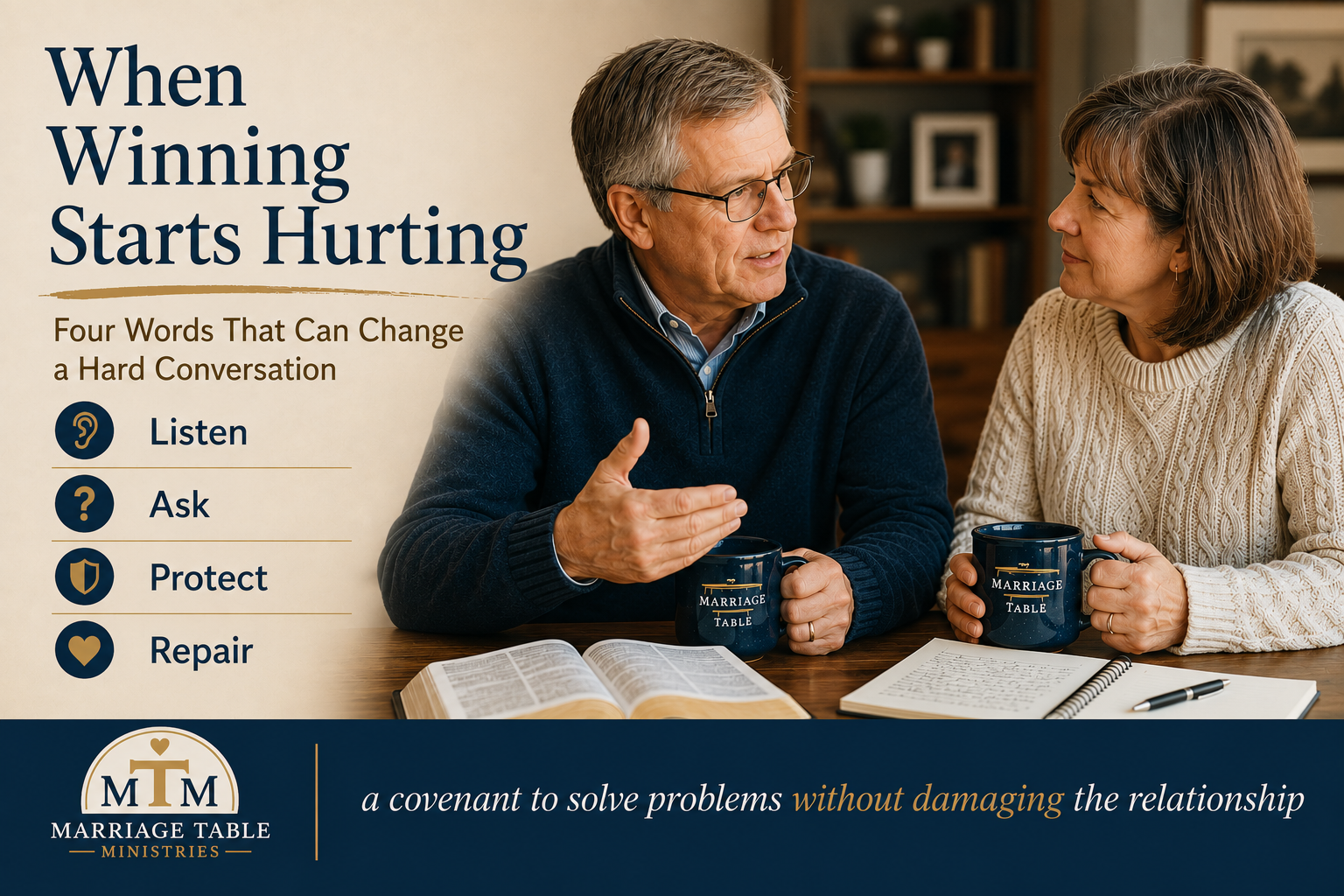
Listen. Ask. Protect. Repair.
Listen for what your spouse means, not only for the part you can answer. What concern, fear, hope, history, or value is underneath the position?
Ask instead of assuming. Ask what matters, what your spouse needs, and what you may be missing. Say what you need clearly without turning it into an order.
Protect your spouse and the relationship while telling the truth. Do not shame, mock, threaten, overpower, or use private information as a weapon.
Repair what your words or actions have damaged. Stop. Name what happened. Apologize when you need to. Then return to the conversation differently.
We now call these four practices LAPR. The words are easy to remember. Living them in the middle of a tense conversation is another matter.
Not a Technique for Winning More Politely
LAPR is not a method for getting your spouse to cooperate.
It is not four steps for winning more politely.
It is a way of saying, “You matter more to me than winning this moment.”
That does not mean the issue is unimportant. Couples need to tell the truth, hold convictions, and address what is not working. Protecting the relationship is not the same as avoiding conflict.
It means I will not use my speed, volume, knowledge, silence, anger, or persistence to make you smaller so I can get my way.
For us, that is part of covenant. We promised to remain married, and we keep learning what it means to love each other inside the parts of marriage that are difficult.
The question is not only, “How do I make my point?”
It is also, “How do I stay faithful to this person while I make it?”
How the Four Words Help
In conflict, LAPR helps slow the damage. Listening makes room for meaning. Asking checks the story we are telling ourselves about our spouse. Protecting keeps hurt from becoming a weapon. Repair gives us a way back after one of us has handled the moment badly.
The same words also help when a couple is not fighting but needs to build an agreement. Money, responsibilities, family expectations, and the changing seasons of marriage all require negotiation.
The goal is not for one person to make the better argument until the other gives in. The goal is an agreement that both people understand and can live inside.
The Marriage Table Lesson
Getting a decision made is not enough. A marriage grows stronger when both people can speak honestly, remain respected, and stay connected while they work toward an answer.
The Next Small Step
Choose one recurring disagreement, but do not begin with the most explosive issue in your marriage. Pick something that matters but is calm enough to practice on.
Set aside fifteen minutes when neither of you is already upset. Let each person speak for two uninterrupted minutes about what the issue means to them. Before responding, ask one honest question, such as, “What am I missing?”
Agree that either of you may pause the conversation if voices rise, sarcasm appears, or one person feels overwhelmed. Before trying to settle the issue, repair anything that has already hurt the conversation.
Either spouse can say:
“Wait. We have forgotten the covenant.”
That sentence is not a way to escape the issue. It is a way to stop making each other the issue.
You do not have to reach a final answer in fifteen minutes. Understanding each other more clearly and agreeing on when to continue is real progress.
Talk About It Together
When we disagree, which of us tends to speak faster, longer, or more forcefully?
What happens inside you when you feel that I am no longer listening?
What helps you feel safe enough to disagree with me honestly?
Is there something about your position that I have assumed rather than asked about?
Which word—Listen, Ask, Protect, or Repair—would most help one recurring conversation in our marriage?
Continue Reading
Continue this series with “The $5,000 Horse: Listening for Meaning, Not Just Words,” another article from The Early Years.
A good marriage is not built by never disagreeing. It is built by learning how to disagree without losing each other.