

Is that the sugar over there?
Marriage Table Ministries • Marriage Through the Seasons
Is That the Sugar Over There?
Ask Clearly, and Do Not Assume in Marriage
Every marriage has moments when one person is sure the message was obvious and the other person has no idea what was being asked. We learned that clear asking is not harsh, and curious questions are not weakness; both are ways of caring for the person across the table.
The Sugar Question
At Patience’s parents’ dinner table, her mother might look across the table and ask, “Is that the sugar over there?”
I would look at the sugar bowl and answer, “Yes.”
Technically, I had answered the question.
What she meant was, “Please pass the sugar.”
Patience understood that immediately. I did not.
The same thing could happen when her mother set a beautiful apple pie on the table and said, “This probably isn’t very good.”
She was not giving the pie an honest review. She was hoping someone would say that it looked wonderful and would probably taste even better.
That was not dishonesty or manipulation. It was the dialect of her home. Requests were softened. Messages were hinted at. Vulnerability often arrived dressed in politeness.
Patience had grown up hearing what was meant beneath the words. I came from a more direct family culture—sometimes too direct.
She might hint. I might answer literally.
I might speak plainly. She might experience my plainness as sharper than I intended.
We were speaking the same language, but we were not always using the same dictionary.
What Patience Heard
Patience did not experience her family’s way of speaking as confusing. It felt considerate.
A softened request left room for the other person and avoided sounding demanding. A direct request, especially in a tense moment, could feel abrupt.
From her side, the meaning was clear because she had learned to notice tone, timing, expression, and the details around the words.
From my side, a question looked like a question.
“Is that the sugar over there?”
Yes, it was.
Neither of us was trying to make communication difficult. We were each using habits that had worked in the homes where we grew up.
Marriage exposed the limits of both styles.
Every Marriage Is Bilingual
Couples bring more than personalities into marriage. We bring family habits, emotional rules, assumptions, and ways of asking for what we need.
In one family, people say exactly what they want. In another, a direct request sounds demanding. One spouse may believe that loving people should notice what needs to be done without being asked. The other may believe that adults should simply say what they need.
Neither style is automatically better.
Direct people can become blunt, impatient, or controlling. Indirect people can become unclear and then resentful when the other person misses the message.
The trouble begins when we assume our way is normal and our spouse’s way is the problem.
For us, learning to communicate well did not mean choosing one family dialect and discarding the other.
Patience needed room to make clearer requests without feeling rude. I needed to ask more questions before deciding that her words meant only what they said on the surface.
Over time, we learned that love is not only speaking honestly. It is also learning how the other person hears.
Three Ways a Need Can Be Spoken
A need can usually be communicated in one of three ways.
A request is clear and leaves room for conversation.
A demand tries to control the answer.
A hint asks the other person to discover the request without being told.
Consider the difference:
Request: “I need more help this week. Could you handle dinner on Tuesday and Thursday?”
Demand: “You had better start helping around here.”
Hint: “It must be nice to have nothing to do after work.”
All three may come from a real need. Only one gives the other person a fair chance to respond without first sorting through accusation, pressure, or guesswork.
Clear requests are not weak. They require us to name what we need and risk hearing an honest answer.
Why We Hint
Hinting often feels safer than asking directly.
A clear request creates the possibility of a clear no. It shows how much something matters. It may make us feel needy, demanding, or exposed.
A hint gives us a little protection.
Instead of saying, “I would like some help tonight,” we may say, “There is certainly a lot to do.”
Instead of saying, “I miss you,” we may say, “You have been busy lately.”
Instead of asking for reassurance about the pie, we may say, “This probably isn’t very good.”
The listener is then expected to recognize the request hidden inside the observation.
Sometimes that works. Often it does not.
When it fails, the person who hinted may feel ignored. The person who missed the hint may feel accused of failing a test they did not know they were taking.
Why We Assume
The listening spouse has a different temptation: deciding too quickly what the other person means.
We hear a request and assume criticism. We hear hesitation and assume resistance. We hear a question and assume control.
A spouse says, “Are you going to be working late again?” The listener may hear, “You care more about work than you do about me.”
That may be the message. It may also be a practical question about dinner.
A hard conversation gets harder when we answer the motive we have imagined instead of the words our spouse actually spoke.
A curious question slows that down.
“Are you asking about the schedule, or are you feeling that I have been gone too much?”
“When you say you need help, what would be most useful?”
“Is this mainly a preference, or does it touch something deeper for you?”
A good question does not weaken the conversation. It keeps us from fighting with a meaning our spouse may never have intended.
A Simple Test Before You Speak
Before making a request, ask yourself three questions:
Is it clear? Could my spouse describe exactly what I am asking?
Is it specific? Have I named a practical action, time, or decision?
Is it open? Am I leaving room for my spouse to answer honestly, or am I using guilt, anger, silence, or spiritual language to force agreement?
For example, “I need more help” may be honest, but it is still broad. “Could you handle bedtime on Monday, Wednesday, and Friday this week?” gives your spouse something concrete to consider.
Clarity does not make every request rigid. It simply reduces the amount of guessing required.
Ask What Lies Underneath
The other side of asking is curiosity.
When your spouse makes a request, objects to a plan, or reacts more strongly than you expected, do not rush to explain why the response is unreasonable.
Ask:
“Why does this matter to you?”
“What are you concerned might happen?”
“Is this a principle, preference, fear, habit, or wound?”
The answer may not settle the disagreement. It may show that you have been discussing two different things.
One spouse may be talking about efficiency while the other is talking about respect. One may be talking about money while the other is talking about security. One may be asking for a practical change while the other hears a judgment about character.
Good questions bring the real conversation into the room.
By God’s grace, we have had years to learn each other’s dialects. We still miss things. We still answer too quickly or expect the other person to understand what we have not clearly said.
A strong marriage is not built by two people who communicate perfectly. It is built by two people willing to clarify, ask again, apologize when necessary, and keep learning.
The Marriage Table Lesson
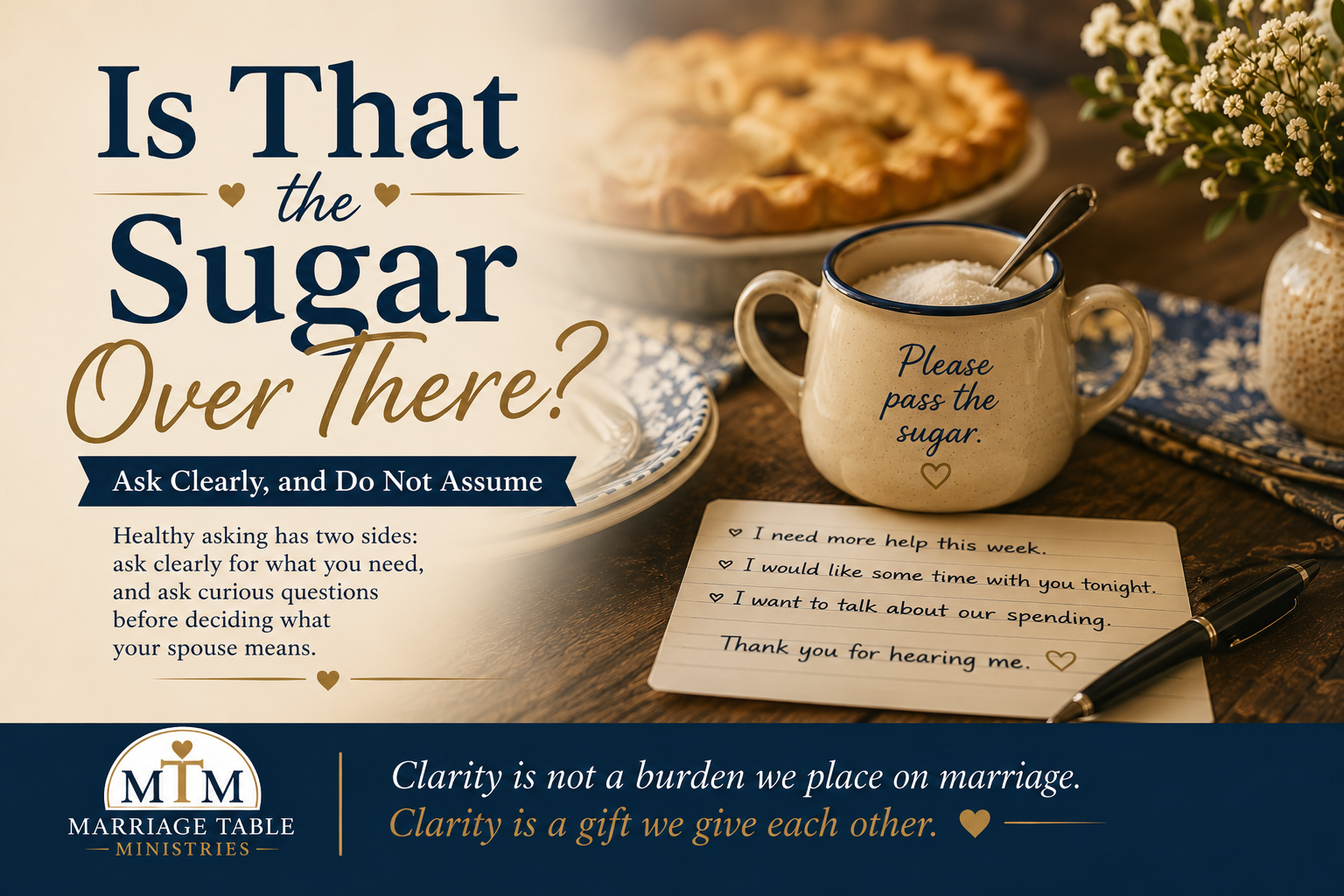
Healthy asking has two sides: say clearly what you need, and ask curious questions before deciding what your spouse means.
The Next Small Step
Choose one request you have been communicating indirectly. Keep the practice small enough to finish in ten minutes.
First, write down the hint or frustrated sentence you have been using. Then rewrite it as one clear request that names a practical action.
For example:
Hint: “We never spend any time together.”
Clear request: “Could we put our phones away and sit together for twenty minutes after dinner tonight?”
Say the clear request to your spouse. The listening spouse should ask one question before answering: “What would this mean to you?” or “What would this look like in a practical way?”
Then respond honestly. A request is not an order, but it deserves a thoughtful answer.
Talk About It Together
What have I expected you to know without ever asking for it plainly?
When I hint instead of asking, what am I afraid might happen?
When do my direct words feel helpful, and when do they feel sharp?
What assumption do we make most often about each other’s motives?
What is one request we could make more clearly this week?
Continue Reading
Continue this series with “When Being Right Is Not the Highest Good,” another article from The Early Years about protecting your spouse and the marriage during difficult decisions.
Clarity is not a burden we place on marriage. Clarity is a gift we give each other.