When being right is not the highest good
Marriage Table Ministries • Marriage Through the Seasons
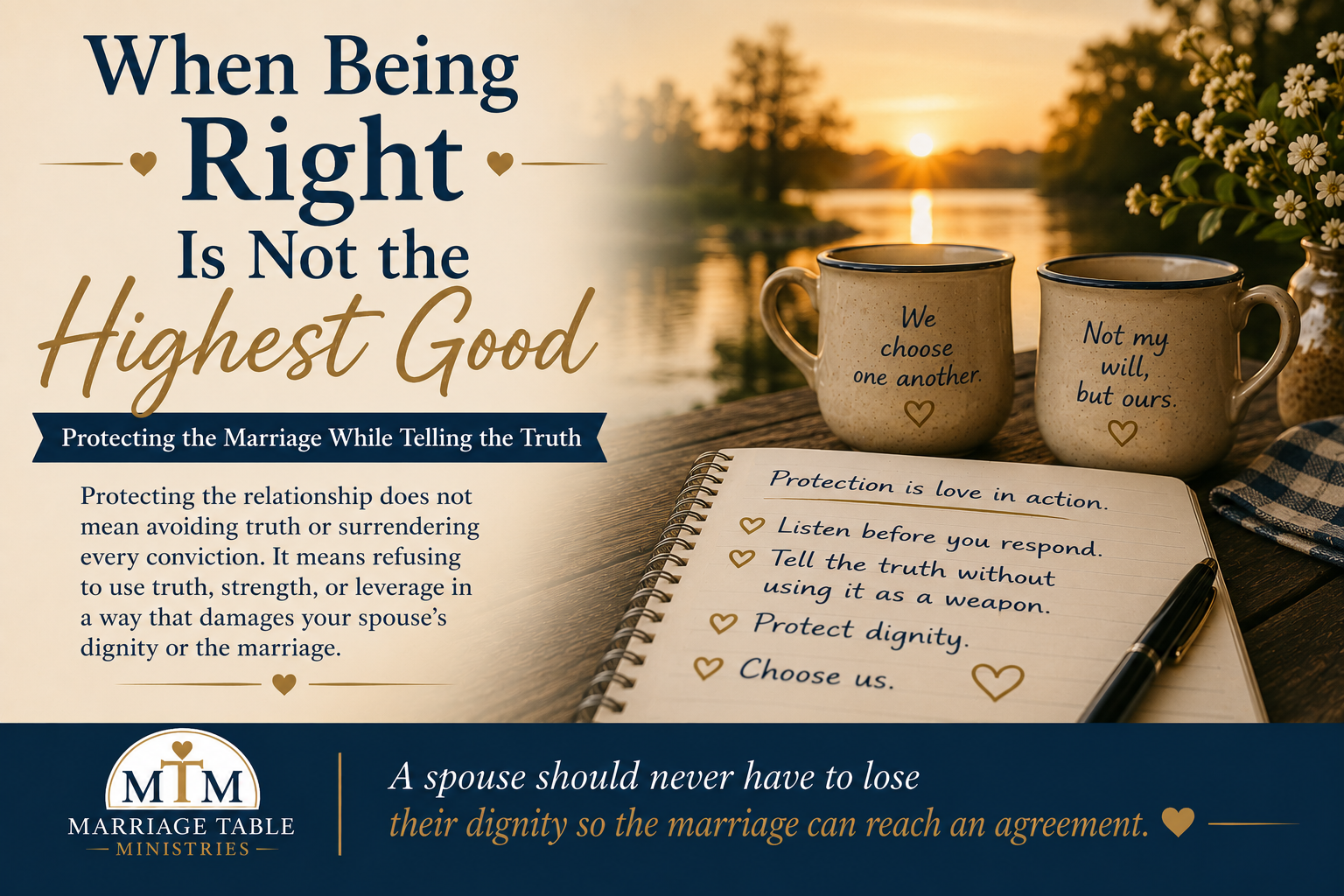
When Being Right Is Not the Highest Good
Protecting the Marriage While Telling the Truth
Some marital decisions do not offer a comfortable compromise. Our disagreement after Ralph’s death taught us that telling the truth is not enough; we also have to pay attention to what our way of handling the truth may do to the person we love.
Two Sacred Values Collide
After Patience’s father, Ralph, died, we faced one of the hardest decisions of our marriage.
I had promised Ralph that we would care for Ella, Patience’s mother. The settled plan was that after his death, she would leave North Dakota and move into our home in Minnesota.
Then Ralph died, and Ella refused to come.
From my point of view, the promise was clear. I had given Ralph my word, and bringing Ella home seemed like the most faithful way to keep it.
Patience was looking at her mother, not only at the plan.
Ella was grieving. She was still capable of making her own decisions. She was deeply attached to the place and life she knew. Patience believed that caring for her mother required respecting her right to choose.
I was thinking about promise and protection.
Patience was thinking about dignity and freedom.
Neither concern was small. Neither of us was trying to be difficult. We were each trying to honor something that mattered deeply.
No Painless Middle Ground
Some disagreements can be softened by compromise. This one could not.
Ella could not live in both states. She would either come to Minnesota or remain in North Dakota.
There was no clever third option that allowed everyone to feel satisfied. One outcome would prevail, and one of us would have to live with a decision we did not believe was best.
Patience remembers the human reality of that. This was not a problem on paper. It was her mother, newly widowed, deciding where and how she would live.
I remember the moral weight of the promise. I had told Ralph we would care for her.
Both memories are true. That is part of what made the decision so difficult.
The Danger of Leverage
I also knew I had leverage.
I believed I could insist. I believed Patience would probably comply.
For a time, that knowledge made the decision feel simpler. If I was convinced my position was right, why not use the authority, persistence, or strength available to me to make it happen?
But another question began to trouble me:
What kind of husband would I become if I used my strength to force this decision?
Every marriage has uneven places of power.
One spouse may speak faster, earn more, know the finances better, carry greater spiritual confidence, or feel more comfortable with conflict. The other may need time, fear disapproval, or give in simply to end the pressure.
Power is not always loud. Silence can be power. Withdrawal can be power. Tears can be used as power. So can Bible verses, expertise, money, anger, persistence, or the threat of disappointment.
Marriage gives us influence over each other. The question is what we do with it.
Strength can serve the relationship, or it can make the other person smaller.
How Pressure Becomes Control
Pressure begins to replace partnership when one person cannot disagree without paying a relational price.
One spouse keeps explaining after the other has asked for time.
The conversation ends only when one person gives in.
Affection, warmth, money, spiritual approval, or ordinary cooperation is withheld until agreement is reached.
One spouse says yes but becomes quiet, anxious, resentful, or emotionally absent afterward.
Private fears or past failures are brought into the argument to weaken the other person’s position.
The stronger spouse may not intend to control. I did not think of myself that way. But intent is not the only measure. We also have to notice what our way of handling the issue is doing to the other person.
The Deeper Question
I did not stop believing that bringing Ella to Minnesota was wise. I did not decide that my promise to Ralph no longer mattered.
But I began to see that being convinced was not the same as being entitled to force Patience’s surrender.
In a hard decision, we usually ask, “Am I right?”
That question matters. Truth matters. Wisdom matters. Convictions should not be abandoned simply because disagreement is uncomfortable.
But covenant marriage adds another question:
“What could my way of handling this do to us?”
I could have reached the outcome I wanted and left a wound that lasted much longer than the decision itself.
So I told Patience that because this was her mother, she should make the final decision.
I was not pretending I no longer had an opinion. I was choosing not to use my leverage in a way that might damage her dignity or our marriage.
Patience did not have to defeat me in order to protect her mother. I did not have to overpower her in order to prove that my promise mattered.
We could remain husband and wife while carrying different convictions about the decision.
That did not make the situation painless. It did mean that being right was no longer the only good we were trying to protect.
What Protect Means
Protect is one of the four practices we use in hard conversations: Listen, Ask, Protect, and Repair.
Protect does not mean hiding the truth or pretending everything is fine. It means refusing to use truth, strength, leverage, or vulnerability in a way that damages your spouse.
Protect means you do not mock a concern because it seems emotional or impractical to you.
You do not punish honesty by withdrawing affection, becoming threatening, or making your spouse regret speaking openly.
You do not use private information, old wounds, or confessed fears as leverage in the next disagreement.
You do not use spiritual language to force surrender. “God told me” can close a conversation before the other person has had room to speak.
You protect the slower processor and the quieter voice. Speaking less quickly does not mean having less wisdom.
Patience has often helped me see that the emotional cost of a decision is still a real cost. I have sometimes helped us step back and name the larger principle. We need both kinds of seeing.
Protect asks us to handle our spouse’s trust as something sacred, especially when the conversation is difficult.
What Protect Does Not Mean
Protecting the relationship does not mean avoiding the issue.
It does not mean erasing your own needs, surrendering every conviction, or calling unhealthy surrender “peace.”
It does not mean tolerating abuse, coercion, threats, or controlling behavior. Safety may require outside help, firm boundaries, or physical separation from danger.
Protection is not passive. It is disciplined strength.
It tells the truth without humiliating. It holds a boundary without contempt. It makes room for disagreement without making the other person pay for disagreeing.
Sometimes protecting the marriage means yielding. Sometimes it means speaking more clearly. Sometimes it means refusing to continue a conversation until both people can participate without fear.
We have not always done this well. A strong marriage is not built by two people who never misuse their strength. It is built by two people who notice, repent, repair, and keep choosing a better way.
The Marriage Table Lesson
Protecting the relationship means telling the truth without using your strength, knowledge, emotion, or leverage to damage your spouse’s dignity.
The Next Small Step
Choose one disagreement in which one of you clearly has the stronger voice. Do not begin with the most painful issue in your marriage.
Set aside fifteen minutes. The stronger speaker goes second.
The quieter or slower-processing spouse speaks first for three uninterrupted minutes. The listener may take notes but may not correct, explain, or defend.
The listener then summarizes: “What I hear you saying is…” and asks, “Did I get that right?”
Only after the speaker feels accurately heard should the other spouse explain their position.
Before ending, agree on one protection boundary for the next conversation: no interrupting, no threats, no spiritual claims used to close the discussion, or a planned pause when either person feels overwhelmed.
You do not have to make the final decision today. The point is to make sure both people remain present, respected, and able to speak.
Talk About It Together
Where do I have the stronger voice in our marriage?
What do I do, intentionally or unintentionally, that makes it harder for you to disagree with me?
When have you felt protected by the way I handled a difficult truth?
What kind of power are we most likely to misuse—words, silence, money, emotion, spiritual language, or persistence?
What protection boundary would help one unresolved conversation go better?
Continue Reading
Continue this series with “Repair Is More Than Saying I’m Sorry,” another article about caring for the relationship after words or actions have caused harm.
A spouse should never have to lose their dignity so the marriage can reach an agreement.