

The Voice I Never Wanted to Hear
Marriage Table Ministries • Marriage Through the Seasons
The Voice I Never Wanted to Hear
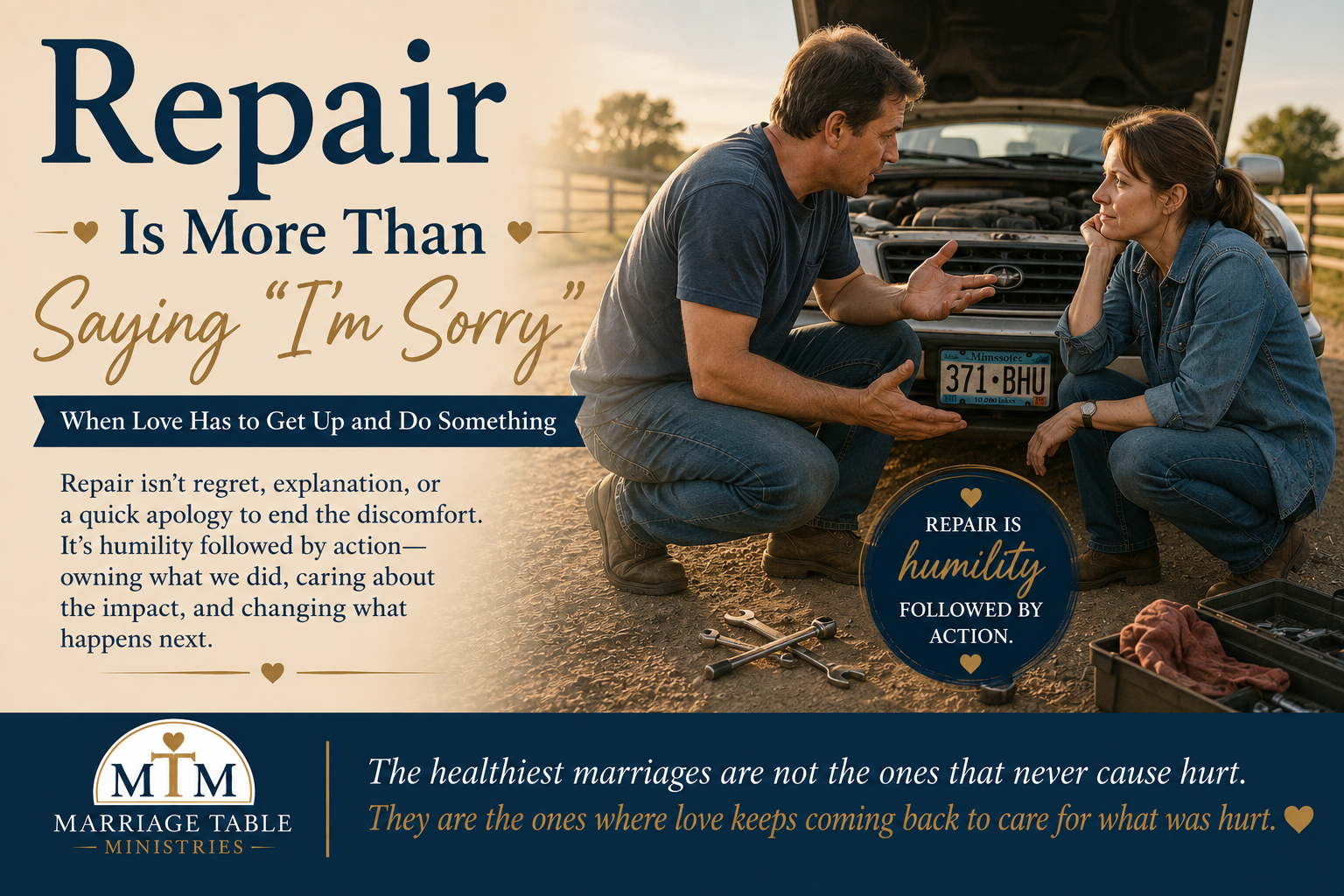
Repair Is More Than Saying “I’m Sorry”
Every marriage causes hurt, even when neither person intends to do damage. We learned that an apology matters, but repair begins when we care enough about the hurt to do something different next.
The Voice I Never Wanted to Hear
Early in our marriage, I was trying to tow a broken car.
The situation had nearly everything that made me vulnerable to frustration: a vehicle that would not work, limited money, a practical problem that had to be solved, and the feeling that I ought to know how to solve it.
Patience was helping.
I became frustrated with the way she was assisting and yelled at her.
Even while the words were coming out, the voice sounded familiar.
I had heard that tone before. I had grown up watching my father carry the frustration of farm problems into the house and direct it at my mother.
I had promised myself I would never speak to my wife that way.
Then I heard the same pattern coming out of my own mouth.
That was the part I could not talk my way around. I was not only embarrassed by what I had said. I was hearing an old family pattern begin to settle into our marriage.
I had believed that rejecting the pattern was enough. That moment taught me otherwise. Saying, “I will never do that,” is not the same as learning what to do when pressure rises.
What Patience Saw
Patience could see the pressure underneath my reaction.
The car mattered. Money was tight. The towing problem had to be handled, and I was feeling responsible for making it work.
She gave me grace.
But her grace did not make the yelling harmless. She could understand why I was under pressure and still know what it felt like to have that pressure aimed at her.
That is one of the gifts Patience has brought to our marriage. She notices the practical strain in a room, but she also notices what that strain is costing the people in it.
She saw that I was frightened and frustrated. She also knew she had been treated unfairly.
Her understanding did not remove my responsibility.
Stress explained what happened. It did not excuse it.
How to Know Repair Is Still Needed
Sometimes an argument ends, but the hurt does not.
Your spouse may become guarded when the subject returns. One of you may replay the incident, avoid a similar situation, or carry the hurt into a later disagreement.
Another clue is that the apology focused mainly on intent:
“I did not mean it that way.”
“You know I was under a lot of pressure.”
Those things may be true. But they do not answer the question your spouse may still be carrying: Do you understand what that moment was like for me?
Repair is also unfinished when the same behavior keeps happening and no one has named what needs to change.
An apology may close the conversation for the evening. Repair helps make the next conversation safer.
Intent Does Not Erase Impact
Most spouses do not wake up planning to wound each other.
We are tired, afraid, embarrassed, hurried, disappointed, or overwhelmed. We speak sharply, withdraw, make a cutting remark, forget something important, or turn a practical problem into a judgment about the person beside us.
Then we explain.
“I was under a lot of stress.”
“That is not what I meant.”
“You know I would never try to hurt you.”
Those explanations may be honest. They may help the other person understand the circumstances. But they do not erase what happened.
A broken car can be fixed while the words spoken beside it remain unfinished.
Repair begins when we stop using our intent as the final measure and become willing to care about the impact.
What Unrepaired Hurt Does
Not every injury in marriage is dramatic.
Many are small enough to dismiss: a harsh tone, an eye roll, a promise forgotten, a private concern repeated to someone else, a joke that embarrassed the other person, or a conversation ended by walking away.
Because the incident seems small, we may decide it should simply be forgotten.
But unfinished hurt has a way of entering later conversations.
The next disagreement is no longer only about the present issue. It is also carrying the last time one spouse felt dismissed, mocked, ignored, or left alone.
Over time, small injuries create caution. One spouse speaks less honestly because honesty has not felt safe. The other cannot understand why ordinary conversations now carry so much tension.
Repair keeps small wounds from becoming part of the atmosphere of the marriage.
What Genuine Repair Includes
Repair does not require a polished speech. It does require honesty.
First, stop the harmful pattern. If your voice is rising, stop speaking. If you are using sarcasm, put it down. If the conversation has become unsafe, pause it and agree on a time to return.
Then name specifically what you did.
“I yelled at you.”
“I dismissed what you were saying.”
“I used something private against you.”
A specific apology leaves less room to hide behind generalities.
Next, acknowledge the impact. Do not tell your spouse how they felt. Ask: “What was that like for you?” Then listen without correcting the answer.
Apologize without adding “but.” The word after “but” often turns an apology back into a defense.
Ask what would help. Sometimes the answer is another conversation. Sometimes it is completing what you neglected, replacing what you damaged, changing a plan, or simply giving your spouse time.
Then change what happens next.
Without changed behavior, repeated apologies begin to sound like permission slips.
Finally, reconnect without demanding immediate closeness. Repair offers a way back; it does not set a deadline for the other person’s feelings.
What Repair Is Not
Repair is not saying, “I’m sorry you felt that way.” That puts the problem inside your spouse’s reaction instead of inside what happened.
Repair is not explaining until the apology disappears.
It is not pressuring the hurt spouse to forgive quickly so the person who caused the hurt can feel better.
It is not demanding immediate warmth, reassurance, or physical closeness after saying the right words.
And it is not repeating the same apology while making no effort to change the pattern.
Forgiveness matters deeply in covenant marriage. But forgiveness and repair are not competing ideas.
Grace does not ask us to pretend harm did not happen. Grace gives us the courage to tell the truth, receive mercy, and begin practicing a different way.
Four Sentences That Can Begin Repair
When a moment has gone wrong, begin before you have assembled the perfect explanation:
“That came out wrong. Let me try again.”
“I was unfair to you.”
“I understand why that hurt.”
“What do I need to do to make this right?”
These sentences help because they move toward the hurt instead of away from it.
Love says, “Those words were wrong,” and then gets up and does what is needed.
Replacing the Pattern
The towing incident showed me that rejecting my father’s pattern was not enough. I had to replace it.
That replacement happened slowly.
I had to learn to recognize pressure earlier, name what was happening inside me, and stop treating Patience as though she were the cause of a problem she was trying to help solve.
Patience had to decide more than once whether my apologies were being followed by enough change to trust the next conversation.
We did not build a strong marriage by never repeating an old failure. We built it through years of noticing, confessing, forgiving, talking again, and choosing a better response the next time.
We are grateful that God’s grace kept meeting us in the places where we had to tell the truth about ourselves.
Grace has not made us people who never need repair. It has made repair possible.
The Marriage Table Lesson
Repair is not regret, explanation, or a quick apology meant to end discomfort. Repair is humility followed by action.
The Next Small Step
Choose one small hurt from the past week that still feels unfinished. Do not choose the oldest or most painful issue in your marriage.
The spouse who caused the hurt begins with three sentences:
“What I did was…”
“I can see that it affected you by…”
“What would help repair this?”
The hurt spouse answers only about that one moment. Avoid attaching every similar incident from the history of the marriage.
Agree on one concrete action: change a behavior, complete a responsibility, return to a conversation, replace something damaged, or check in again tomorrow.
End by naming when you will follow through. Repair becomes more trustworthy when the next step is clear and completed.
Talk About It Together
What hurt have we treated as too small to repair even though it is still affecting us?
When I apologize, what helps you believe I understand the impact?
Do I tend to explain, withdraw, minimize, or become defensive when I have caused hurt?
What inherited pattern are we trying to replace in our marriage?
What practical action communicates repair to you?
Continue Reading
Continue this series with “When Winning Starts Hurting,” another article from The Early Years about using Listen, Ask, Protect, and Repair during difficult conversations.
The healthiest marriages are not the ones that never cause hurt. They are the ones where love keeps coming back to care for what was hurt.